About the
Resource Center
Who We Are
Our Beginnings
Collaborative Effort, Consortium Led
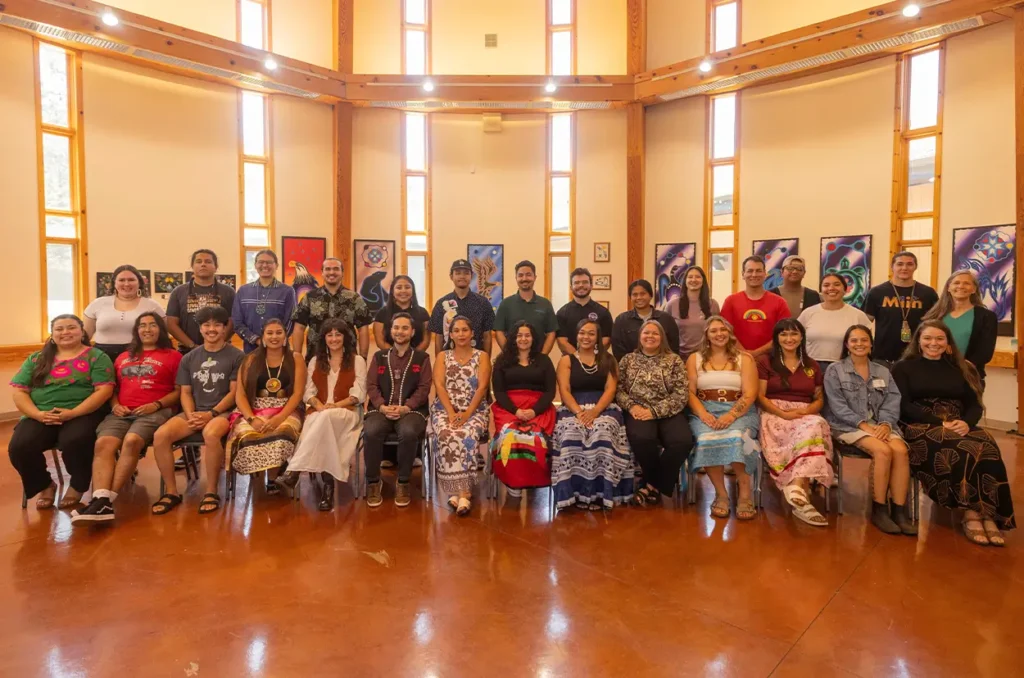
This initiative is a collaborative effort involving key partners and is also linked to the Regional Native American Language Resource Centers. The Center is led by a consortium including the University of Hawaiʻi at Hilo, the University of Alaska Southeast, and Lac Courte Oreilles Ojibwe University in Wisconsin. The Center is supported by the U.S. Department of Education.
Our Purpose
Bridging Ancestral Wisdom Across Generations
Preserving Indigenous Languages
Reliable Partner in the Movement
History
Mokuola Honua
Mokuola Honua Global Center For Indigenous Language Excellence is named for the small island in Hilo Bay called Mokuola. Literally, an “island of life and healing,” Mokuola is a traditional healing site for Native Hawaiians.
A number of incredible resources were created and gathered during the creation of Mokuola Honua, which was started to be a gathering place – both physical and virtual – fostering collaborations on a wide range of Indigenous issues and strategies, all of which are grounded in strong language fluency.
This was the foundation of what became Aanikoobijigeng, the National Native American Language Resource Center. The resources gathered at Mokuola Honua can be accessed using the link below.
Key Partners
Co-Principals:
Demonstration Sites:
Regional Resource Centers
Northwest Region Native American Language Center
Northwest Indigenous Language Institute
at University of Oregon
https://nili.uoregon.edu/nalrc
The Northwest Indian Language Institute (NILI) has been awarded a U.S. Department of Education. Established in 1997, NILI is now one of four Native American Language Resource Centers, all focused on Indigenous communities and language revitalization education. The designation adds resources to NILI’s work and broadens our reach to include tribes and communities in Washington, Idaho, Montana, Alaska, and, as always, Oregon.
The goals of this expanded NILI:
- Support the use of Native American languages in education systems by helping create language courses.
- Support the recruitment and development of Native American language teachers in education systems.
- Support Native American language programs as they find and apply for federal resources to support language programs.
- Support Native teachers and language programs at any educational system by gathering and developing material, research, models, programming, curriculum, and assessment through the NILI Resource hub.

West Regional Native American Language Resource Center
American Indian Language Development Institute
https://aildi.arizona.edu/west-nalrc
The West Regional Native American Language Resource Center (West NALRC) is building on the American Indian Language Development Institute (AILDI)’s 40 years of success and ongoing work in support of Indigenous language efforts in communities of the West region – Arizona, California, Nevada and Utah. The West NALRC is located within AILDI and works closely with our partner institutions Tohono O’odham Community College, San Carlos Apache College, and Diné College.
The Center’s purpose is to:
- Provide support and advocacy for the inclusion of Native American languages in local, state and regional educational systems;
- Provide training and technical assistance in implementing evidence-based pedagogical strategies, assessments, qualifications and processes for Native American language medium instruction;
- Provide technical assistance to Native American Language Programs in the region in implementing and sustaining effective curriculum and other language work.
Midwest Native Language Resource Center
Little Priest Tribal College
https://www.littlepriest.edu/nalrc/
The Midwest Native Language Resource Center (MW-NALRC) is a regional hub which provides technical assistance and support to Native American language schools and programs. We are the only NALRC hosted at a tribal college.
Our service area is the central region of the United States (Nebraska, South Dakota, North Dakota, Wyoming, Kansas, Missouri, and Colorado).