
Models of Education

Medium Education
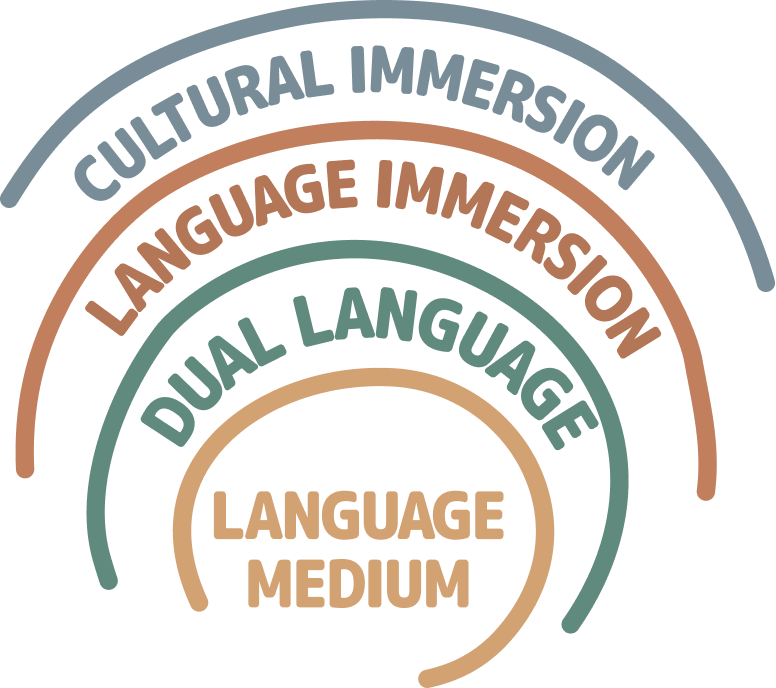
Aanikoobijigeng believes that language medium education is the most secure way to ensure endangered languages survive and thrive. Medium education means that the target language is the language of power and use, and that content is taught through the language. The level of endangerment and the number of available resources—teachers, state of curriculum development, alignment of ideas, facilities, and budget—will determine what options are currently available. Also, ensuring that the language is being used between generations is a critical factor.
Move to The Center
Language Schools and Programs should work with their language communities and resources to determine what is possible. Ideally, things will move towards language medium education to ensure high fluency and transfer rates. It is possible to have multiple systems if resources allow, and to migrate language learners with high ability and the right learning and use environments towards language medium education.
Cultural Immersion
Language Immersion
These programs are designed to teach the language to non-speakers and rely on immersive environments. Because the language is still a subject, high fluency is difficult to achieve.
Language use is often not the goal but instead teaching basic speaking abilities.
Dual Language
This is a split program with dedicated time spent teaching through the Indigenous language and dedicated time teaching through English. High fluency is possible and likely because the language is a medium during select portions of the day, which can be increased.
Language Medium
Teaching through the language and existing in the language assures that high fluency levels will be achieved and an Indigenous worldview can be constructed. Teaching through English is not allowable, but teaching English through the Indigenous language is permissible.
Historically Speaking
Many folks have suggested that languages need to be in the home to be alive, and while this is true, an educational system built with an Indigenous language at the center can help restore a language to the home. For Native American languages in particular, education may seem like a foreign place for Indigenous languages, but that is because education in North America was one of the most destructive colonial forces that resulted in language endangerment across the continent and Pacific Islands.
Language Loss During Boarding Schools
The history of the Boarding School Era in the United States, known as the Residential School Era in Canada, was a time of widespread inhumanity and attempted genocide. Indigenous languages were almost always banished within education, and often within the community, while adoption of the oppressor language was then , and were attached to the attainment of citizenship and employment. Children were often removed from their homes and forced to attend schools where their names, languages, and identities were denied to them. These atrocities have been documented, but the governmental and church initiatives to avoid language loss have been few and far between in terms of substantive changes and efforts. For more information on the history of Boarding Schools and what can be done to help Indigenous peoples, communities, and languages to recover, please connect with organizations like the National Native American Boarding School Healing Coalition (NABS).
Advocate for Increased Government and Christian Commitments
To contribute to Indigenous language health, please advocate for increased governmental and Christian commitments to supporting Indigenous language reclamation movements through public acknowledgement and apologies, increases in funding committed to Indigenous language health and stability, increased behavioral health options available to Indigenous communities, and policy changes that result in more educational pathways that include Indigenous languages as mediums of education.